
Radiometry: Detecting Light Levels
- Details
- Category: Shack Talk
- Published on Wednesday, 05 September 2012 03:26
- Written by David L Norris, KG9AE
The emissivity of a body is equal to its absorbance at the same temperature.
G.R. Kirchhoff, Kirchhoff's Law of Radiation.
This article describes a simple radiometer for the measurement of visible and invisible light.
According to "Meteorology: The Atmosphere and the Science of Weather, Fourth Edition", J Moran & M Morgan (isbn:0023833416), Meteorologists use a scale from 1-10 to describe the sky conditions. 1 being completely clear and 10 being completely overcast. Using a simple integrated analog to digital convertor, it should be possible to directly interface the sensor to a computer serial port.
So, you want to build a radiometer
Well, I made it to chapter two of the Meteorology book before I was distracted. Chapter Two: Radiation, Figure 23: Pyranometer; A Pyranometer is a somewhat crude form of radiometer. More specifically, a Pyranometer is a radiometer which measures the intensity of solar radiation striking a horizontal surface. I call it a crude radiometer because it consists of a disc with six 60 degree wedges alternately painted black (absorb desired wavelength) and white (reflect desired wavelength). Not necessarily a literal/visible black and white color mind you, black and white according to the absorbency and reflectance of the materials at the desired wavelengths of radiant electromagnetic (radio) energy. A radio flux measurement is taken by determining the temperature difference between the two surfaces. Two key ingredients, a consistently transparent hemisphere and a detector with a reasonably high radio flux at the desired wavelengths. The goal is to transmit direct plus diffused light to the radio detector. You want to preserve the variance of intensity from sunlight at high angles (direct) versus sunlight striking the surface from low angles (diffused). The higher the angle of radiation, the more concentrated it becomes. A beam of radio waves with a lower radiation angle is spread over a larger surface area. Thus, for accurate results you need to take measurements over a large surface area.
Goals
- Not too crude
- Output variable voltage
- Ridiculously simple
- Detect infrared, visible, and/or ultraviolet wavelengths
We have two options
- A commercial $200+ radiometer
- An array of $0.39 photo-emissive diodes (LED)
Now that we have chosen LEDs
At minimum, an array of three super bright LEDs per wavelength. I choose three sensors because we want to measure the radio flux over a wide surface area. The typical surface area of a large LED is 211.6 sq millimeters (460 x 460 micrometers). Four sensors would be a waste and two sensors would probably not provide an accurate area measurement. I don't think that the spacing would be overly important as long as each LED is evenly spaced at more than 1 centimeter from each other. Each LED would represent a vertex on an equilateral triangle.
The LED should ideally have a perfectly flat lens instead of concave or convex. The LED array should be flush mounted on a cold, with respect to the desired wavelengths, surface. For visible wavelengths we can use either a white LED (RGB composite) or just a yellow (~550 nm) LED. Yellow-Green is the color most sensitive to humans as that is the color of the Sun, so that would be the obvious choice for a daylight 'luminosity' meter. Infrared is simple, an Infrared LED designed for a TV remote. Ultraviolet should be simple. UV LEDs are often used as the exciter in UV LASERs (i.e. photocopiers), so they should be abundant.
With a single 3-LED array, we should have a radio flux of 10 mW per square meter. That isn't much. (A July noon produces about 50 mW per sq cm.) But, it is enough to provide a reasonably accurate measurement of solar radiation. It would not be accurate enough to measure much less than diffused solar radiation as sky conditions are typically recorded in 1/10 increments.
Proof of Concept
For a simple test, grab a volt meter and a visible light emitting diode (I chose a Red 650nm LED for the test because I had one with a big lens ). Connect the LED to the volt meter and expose the LED to various light sources. I get a variance of 0 mV to 1150 mV (dark to light) per LED.
Test Measurements
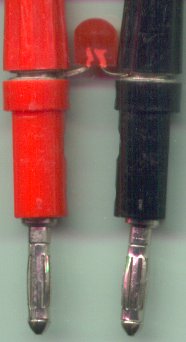
- Reading light, measured from the page of a book
- 50 mV
- Completely overcast sky (09:30 Local) through a triple-pane window
- 120 mV
- 50 W desk lamp
- 350 mV
- 100 W desk lamp
- 650 mV
- 150 W desk lamp
- 850 mV
- Completely clear sky, Direct (15:00 Local)
- 1150 mV
- Completely clear sky, Diffuse (15:20 Local)
- 450 mV
- Dark hallway
- 5 mV